


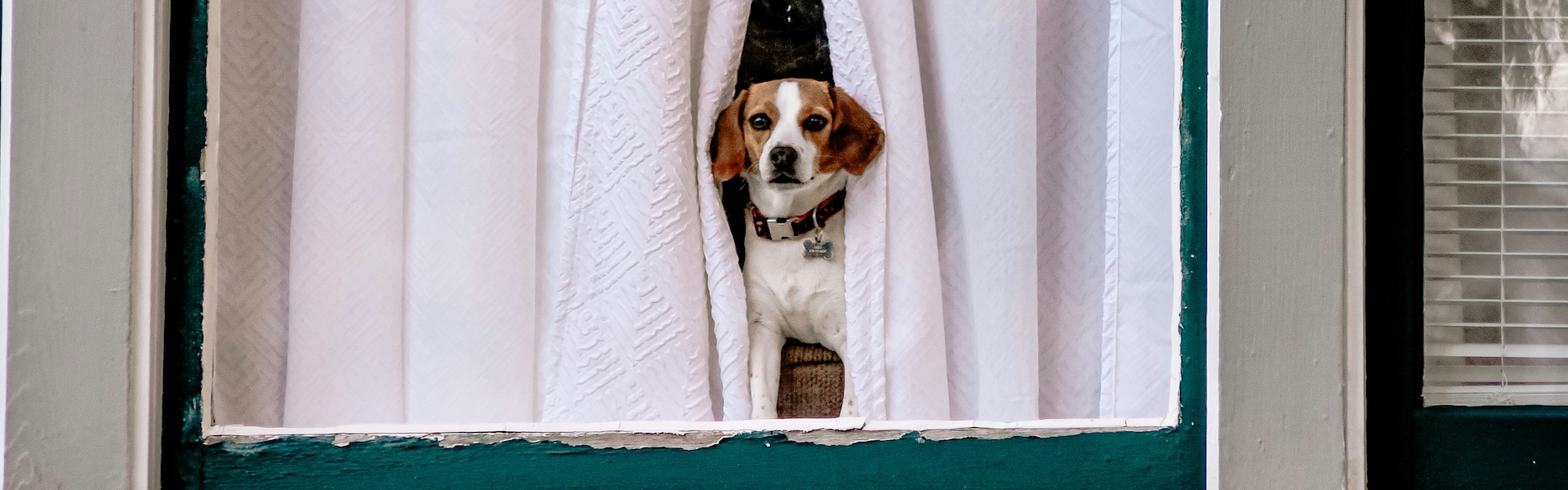
Does your dog have a mental map of your home?
Your dog probably knows your home better than you think. They can head straight to the cupboard where the treats live, find their favourite sleeping spot in the dark and somehow know which room you’ve disappeared into without following you.
That doesn’t necessarily mean they’re carrying around a tiny floor plan in their head, but dogs do seem to build strong memories of familiar spaces.
So how do they navigate so confidently?
How dog spatial memory helps at home
Dogs use memory to learn where important things are. Food bowls, beds, doors, favourite toys and access to the garden can all become fixed points in their everyday environment.
Over time, they learn routes through the house and remember which locations are associated with particular activities.
This is one reason a dog can race towards the back door the moment they hear the word “outside” without needing any further instructions.

Smell gives them another layer of information
For dogs, a room isn’t just something they see. It’s also a landscape of smells.
Furniture, carpets, doorways and people all carry scent, giving dogs another way to recognise where they are and what normally happens there.
Even if a room looks similar to us, your dog may experience it as a completely different place because of its scent profile. Their mental map is probably far more nose-led than ours.
They listen to where you are too
Dogs can also use sound to keep track of what’s happening elsewhere in the house. Footsteps upstairs, a cupboard door opening or the familiar creak of a floorboard can reveal where somebody has gone.
That can make it seem as though your dog somehow knew exactly which room you entered. In reality, they may simply be combining memory with some excellent listening.
Familiar routes become automatic
Think about how easily you walk around your own home at night. You’re not consciously calculating every turn, you’ve simply learned the space.
Dogs appear to develop similar familiarity with places they use regularly. A route from bed to water bowl or from the living room to the garden door can become completely routine.
This may also explain why some dogs confidently move through familiar homes even when visibility is poor.
What happens when you move the furniture?
Rearranging a room can temporarily disrupt those familiar patterns.
Some dogs barely seem to notice, while others may hesitate or investigate the changed area carefully. They’re likely updating their understanding of the space, using sight, scent and repeated movement to learn the new layout.
Older dogs or dogs with reduced vision may find major changes more difficult, which is why keeping important pathways reasonably consistent can sometimes help them.
Your dog knows where the good stuff is
Dogs probably don’t picture a house in the same way humans might imagine a map. Instead, they appear to build up a rich collection of memories based on location, scent, sound and routine. The result is remarkably effective.
They know where everyone usually sits. They know which door leads outside. They know which cupboard contains dinner.
And despite apparently remembering the location of almost everything in the house, some dogs will still spend ten minutes searching for the toy currently underneath their own paw.
