



Arthritis
Welcome to our guide on Arthritis in dogs. When arthritis (also called osteoarthritis) occurs in dogs, it is most commonly found in older dogs, although younger dogs with conditions such as elbow/hip dysplasia, or dogs that have had surgery on their legs e.g Incomplete Ossification Humeral Condyle (IOHC) can develop arthritis. For more about IOHC, see our article on IOHC In Dogs. Osteoarthritis affects in the region of 80% of dogs who are aged 8 or over, it is also the most common form of chronic pain in older dogs.
Arthritis is commonly and mistakenly described as a disease of the cartilage of a joint. It is in fact a disease where all the structures within the joint become inflamed. The inflammation of the joint leads to the destruction of the cartilage, which in turn leads to the synovial capsule becoming eroded and the synovial fluid within the joint capsule becoming thinner. Due to the destruction of the cartilage, the surrounding ligaments will weaken, and the joint becomes unstable.
The body will then lay down new bone to try and ‘stabilise’ the joint (the same as the spine does with spondylosis). Once new bone is laid down around the margins of the joint, it will decrease the joints mobility and range. Along with the new bone, the existing bone underneath the cartilage will start to change shape (see picture). This means that the joints are no longer able to absorb the normal forces of walking and running etc, so it becomes more painful as it is bone rubbing on bone. If the arthritis is not managed, then it can eventually lead to the affected joint completely failing.
The difference between a normal joint and an arthritic joint.
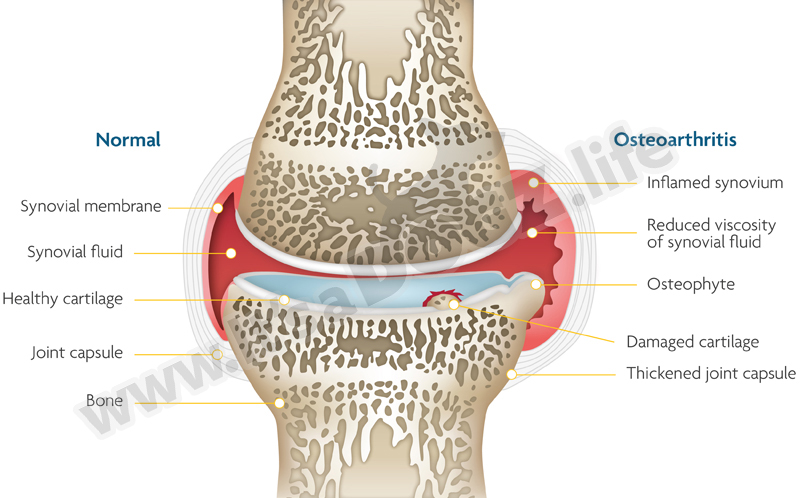
What causes arthritis?
There are a number of things that cause arthritis, most dogs have a combination of several of these factors.
- Body conformation
- Over weight
- Abnormal joint formation eg hip dysplasia
- Activity history – wear and tear
- Previous injury e.g past fractures, ligament injury, muscle injury, or infection in the joint
- Orthopaedic surgery
- Poor/inadequate nutrition.
What are the symptoms of arthritis?
- Difficulty in getting up and lying down
- Stiffness when walking
- Lameness in one or more legs
- Reluctance to jump up/down
- Reluctance to go up/down stairs
- Reluctance to jump on/off
- Reduced stamina
- Stiff, swollen, sore joints
- Reluctance to be touched on some parts of the body
- Unexpected aggression/reactivity towards other dogs/humans.
Treatment for arthritis in dogs
Whilst there isn’t a cure for arthritis, there are many things you can do to make your dog more comfortable. Your vet may prescribe anti-inflammatory drugs, Librela or Cartrophen injections.
- Librela Injection – The active component in Librela is called Bedinvetmed, this is a monoclonal antibody which is a type of protein. This protein is designed to recognise and attach itself to another protein called Nerve Growth Factor (NFG for short). Once it has identified and attached itself to the NFG, it prevents the NFG from attaching itself to the receptors on the nerve cell and interrupting the transmission of the pain signals. Thus lowering the pain level.
- Cartrophen Injection – This works in a completely different way and complements the Librela. Cartophen works by stimulating cartilage production and also by improving the quality and quantity of the production of the synovial fluid within the joint.
There are also some things you can do to help your dog feel a bit more comfortable
- Use an orthopaedic dog bed
- Hydrotherapy/physiotherapy
- Gentle walks
- Ramps for the car
- Joint supplements
We hope you enjoyed reading our guide to arthritis in dogs and found the information provided useful.
We found an article on the Kennel Club website about arthritis, that you might be interested in reading.
Disclaimer: The contents of Itsadogz.life website are for informational and educational purposes only and should NOT replace professional Veterinary Advice. Always consult a qualified Veterinarian regarding your dog’s health and any concerns you may have.
Neither the owners nor creators of this site are engaged in providing veterinary medical services via this site and assume no responsibility for any consequence relating directly or indirectly to any action you take or do not take based on the information, services, products, or other materials provided on this site.
