



Allergy Testing In Dogs
Welcome to our article on allergies in dogs. When talking about allergies in dogs the first place to start is by explaining what an allergy is. An allergy is a physiological immune response to an allergen (e.g. pollen, mould, dust mites to name but a few).
Allergies in dogs, symptoms and testing
Symptoms
The symptoms can vary quite a bit but the most common things that indicate your dog may have an allergy are scratching, recurring ear infections, frequent bouts of reverse sneezing and some get hives. Allergies tend to appear over time and are not always as obvious as you would think. Dogs can have food or environmental allergies or both.
Testing
Environmental Allergy Testing
With environmental allergy testing, there are two ways to identify if there are reactions to the most common pollens, weeds and grasses. The two methods of testing are Blood Serum and Intradermal. The blood test will also include other potentials such as house dust mites, storage mites, fleas and certain moulds as these are also very common triggers.
Blood Serum
A blood sample is taken (no requirement for general anaesthetic or sedation) and then sent to a laboratory for ELISA (Enzyme Linked Immunosorbent Assay) testing. The blood serum is tested for increased IgG and IgE responses to the possible allergens.
Intradermal Allergy testing (IDAT)
This requires a general anaesthetic. The dog has their side shaved and a grid laid out on the skin. Once this is done each allergen contained within its own syringe to avoid cross-contamination is injected into the dermis in one square on the grid. There are usually about 50 allergens that are injected. Once the allergens have all been injected the vet will wait 20 minutes and then look to see if any reactions have occurred (some reactions such as flea can take 24 to 48 hours to appear). Once the reactions have been graded according to a scale produced by the company that supplies the allergens, the vet will produce a report advising what the allergies are.
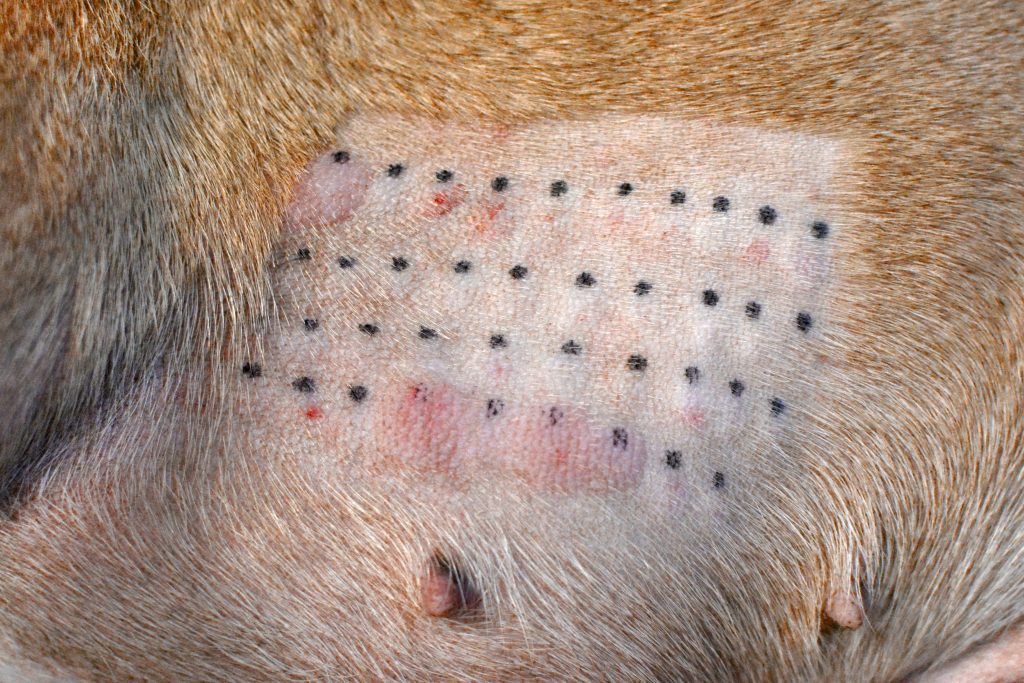
Intradermal Testing (IDAT) skin results
We thought you would be interested to read our other articles on Allergies. Allergy panel results explained, Allergy Medications for dogs and Food Allergies and Elimination Diet.
We found this article on the Davies The Veterinary Specialists website on allergies that we thought you might find useful.
With allergy dogs, you can also find that their behaviour changes when they are having a reaction. They become hypersensitive to touch, hyperstimulated, and hyperactive and you will find they demonstrate more ‘naughty/cheeky’ behaviour, such as stealing items, stealing food, and getting over-excited with play. During the flare, they lose the ability to switch off and be calm, similar to over-tired toddlers who have had too many E-numbers or sugar. Once the reaction subsides then their behaviour returns to normal.
A note on the medication withdrawal and allergy testing
Below are the general guidelines for medication washout periods (the length of time between stopping the medication and the immune system returning to ‘normal’) prior to serum-based allergy testing and intradermal allergy testing. Some general guidelines for medication washout periods prior to intradermal allergy test and serum-based allergy testing are as follows:
- Injectable steroids (long-acting) – 90 days
- Oral steroids including Vanectyl P, Prednisone, etc. – 30 days
- Steroidal skin, ear, and eye ointments (topical therapy) – 14 days
- Antihistamine medications (Piriton, Benadryl, Reactine, etc.) – 7 days
- Tranquilizers including Acevet, Atravet, Clomicalm – 7 days
- Oral & topical essential fatty acids including fish oils – 7 days
- Medicated baths – 5 days
The following medications do not generally need to be discontinued prior to allergy testing unless advised otherwise by your veterinarian:
- Antibiotics
- Antifungals
- Flea Preventive Medications
- Atopica (Cyclosporine)
- Apoquel **
- Thyroid Medication
- Anti-Seizure Medications
- NSAIDS (Non-Steroidal Anti-Inflammatory Drugs)
- Glucosamine
- Heart Medications
** Authors Note: certainly with Apoquel (and possibly atopica/cyclosporine so long as it is not being used to control Inflammatory Bowel Disease) we would recommend talking to your vet about stopping the medication before having any allergy tests, my own dog was on apoquel and had allergy testing and the Lab report stated that the results may not be completely reliable because she was on apoquel at the time the bloods were taken for allergy testing. After speaking with an allergy specialist about food trials, they also suggested that cytopoint should also be stopped because in theory anything that either dampens down the immune system response or modulates the immune system’s response will potentially produce inaccurate results for the food trial.
Disclaimer: The contents of Itsadogz.life website are for informational and educational purposes only and should NOT replace professional Veterinary Advice. Always consult a qualified Veterinarian regarding your dog’s health and any concerns you may have.
Neither the owners nor creators of this site are engaged in providing veterinary medical services via this site and assume no responsibility for any consequence relating directly or indirectly to any action you take or do not take based on the information, services, products, or other materials provided on this site.
