



Incomplete Ossification of the Humeral Condoyal (IOHC)
IOHC in dogs is also referred to as Humeral Intercondylar Fissure – HIF for short, but it is more widely referred to as IOHC. Ossification is the process in which cartilage is transformed into bone. This process begins at 2 weeks of age and is complete between eight and twelve weeks.
IOHC in dogs occurs where the base of the humerus meets the radius and ulna which forms the elbow joint. It is the base of the humerus that fractures. The diagram below shows the joint itself. The cause of IOHC is unknown but there is suspected to be an hereditary component. IOHC affects the following breeds, Springer Spaniels, Cocker Spaniels, Labrador Retrievers, and Rottweilers. Both the Springer Spaniel and Cocker breeds are more commonly affected compared to the Labrador and the Rottweiler.
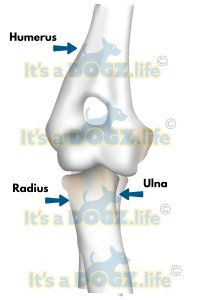
The elbow joint
Diagnosis
The most common sign that owners will notice is lameness on either one or both front legs, which is worse after exercise. The lameness can be mild and intermittent or severe with the response to anti-inflammatory medication extremely poor. If the lameness is severe and x-rays show a fissure (although to be able to pick up the fissure the x-ray beam has to pass right along the fibrous fissure). Failure to pick up a fissure does not rule out IOHC. A CT (computerised tomography) scan needs to be taken to rule IOHC in or out. If the IOHC fissure is shown on the x-ray and CT then a screw can be placed prophylactically to prevent a fracture.
Many dogs present with a fracture having already occurred and owners reporting that it occurred during normal exercise without any trauma.
There are three different types of fracture:
- Lateral Condylar fracture (first fracture)
- Medial Condylar fracture (second fracture)
- Intercondylar fracture – with this type of IOCH the humerus can fracture in one of two ways, a Y shape or a T shape. Examples are shown below.

The Lateral and Medial condylar fracture are repaired with a transcondylar lag screw. The Y and T shaped fractures are slightly different and require specialist vets to perform the operation. Plates as well as transcondylar lag screws are used to repair the fracture. Between the two it is the Y shape that is the most complex to repair as one of the screws sits very close to the ulnar nerve. There is a good recovery rate for IOCH operations, although dogs with IOCH repairs do go on to develop arthritis later on in life (see A guide to arthritis In Dogs)
Authors Note:
Ollie’s Story.
In 2015, We were lucky enough to adopt a springer spaniel roughly 2 years old. In January 2018 we had just started out on a walk and Ollie was off lead, just ambling around. He suddenly yelped and wouldn’t weight bear on his front right. We rushed him to our vets, where they x-rayed and found that his elbow was broken but due to the location, they were unable to repair it.
Our vets then sent his x-ray over to a specialist and referred Ollie at the same time. The specialist vet did a CT scan and found he had IOCH and it had broken in a T shape. Ollie had an operation to pin and plate his elbow and we followed the specialist’s post op rehab advice to the letter and Oille was back running around after his full recovery. Prior to the elbow breaking Oliie had had an intermittent limp.
Unfortunately for him 14 months later he was out walking again and going in and out of a pond when his left elbow broke. Our vets took an x-ray and confirmed he had broken his elbow and we were referred to a different specialist vet, who scanned the leg and said it was IOHC, only this time his elbow had fractured in a Y shape. This is slightly more complicated to pin and plate because one of the pins has to be very close to the ulna nerve.
We again followed the recovery advice to the letter and to this day you wouldn’t know he had both elbows pinned and plated. He is on the Nutravet ‘Nutraquin+’ supplement as he used to have a limp if he overdid the exercise. Dogs do get arthritis in the joint after IOHC, but since being on the Nutravet ‘Nutraquin+’ he doesn’t have a limp after exercising and he’s in and out of the river, running around and swimming all the time.
We found this article by Willows Veterinary Center and Referral Service on humeral-condylar fissures (HIF) for further reading.
Disclaimer: The contents of Itsadogz.life website are for informational and educational purposes only and should NOT replace professional Veterinary Advice. Always consult a qualified Veterinarian regarding your dog’s health and any concerns you may have.
Neither the owners nor creators of this site are engaged in providing veterinary medical services via this site and assume no responsibility for any consequence relating directly or indirectly to any action you take or do not take based on the information, services, products, or other materials provided on this site.
