



The World Of Scent
The extraordinary world of dogs often leaves us in awe, particularly when it comes to their remarkable senses. Among these, a dog’s sense of smell stands out as truly phenomenal. Imagine perceiving the world primarily through scent, a reality for our canine companions. Studies suggest that dogs can smell anywhere from 1,000 to 10,000 times better than humans. This heightened ability offers them a unique perspective, deeply entwined with their experience of the world.
The Anatomy of a Dog’s Nose and How It Works
The intricate design of a dog’s nose is a marvel of nature. When dogs sniff their noses are designed so that air can move both in and out at the same time, thus creating a continuous circulation of air, unlike humans who can only breathe in or out. This sophisticated system allows them to process scents with astonishing efficiency. Moreover, dogs possess over 200 million olfactory receptors in their nasal cavities, enabling them to detect a vast array of different odours, even at low concentrations. The sheer number of receptors multiplies their ability to identify an immeasurable number of scent molecules.
A dog’s nose structure is not just about inhaling scents; it’s also about exhaling in a way that helps them capture more information. When dogs breathe out, the air exits through slits at the sides of their noses, creating swirling air currents that draw in new odours
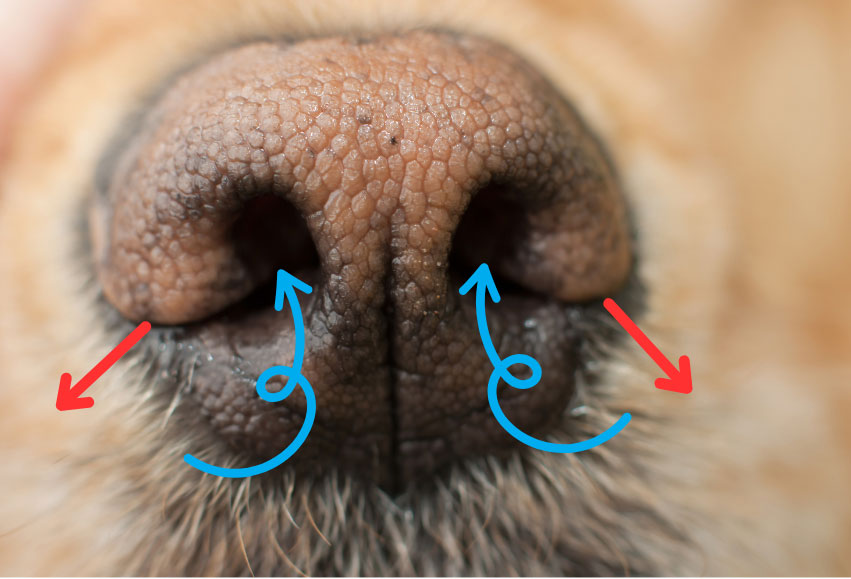
This means that a dog can take in a fresh wave of scent molecules with every sniff, allowing for continuous and detailed analysis.
Additionally, the nasal cavities of dogs are divided into separate chambers. One path is for breathing, and the other is for olfaction. This means that dogs can keep inhaling fresh air even while they’re engaged in deep scent analysis. This unique anatomy enables dogs to build a layered, complex understanding of the scents they encounter, making their noses incredibly powerful tools for navigating their world.
The Power of a Dog’s Olfactory Bulb
The olfactory bulb in dogs significantly enhances their scent detection abilities. It plays a dual role of sensory and modulatory, effectively filtering out background odours to focus on the target scent. The olfactory bulb is essential in increasing the odour detection sensitivity, ensuring that even the faintest traces can be identified. This is achieved through a unique combination of olfactory neurons and specialised airflows within the nasal passage, paired with specific central processing mechanisms. It is these factors that allow dogs to identify far lower odour concentrations than humans.
The olfactory bulb’s intricate design means it can differentiate between thousands of different odours, each with its own distinct molecular signature. This ability is akin to humans recognising different colours or musical notes. Furthermore, dogs’ olfactory bulbs have a high density of nerve cells dedicated to processing scent information, providing a more nuanced and detailed interpretation of the smells they encounter.
Interestingly, the olfactory bulb also communicates with other parts of the brain, such as the hippocampus, which is involved in memory and spatial navigation. This connection helps dogs remember and locate specific scents over time and distance, making their sense of smell not just a tool for immediate detection but also a means of understanding their environment on a deeper level.
In essence, the olfactory bulb’s complex and highly specialised nature equips dogs, with an extraordinary ability to process and interpret a wide array of scents, playing an indispensable role in their interaction with the world.
The Nose Knows: Scent Detection Abilities
A dog’s scent detection capabilities are nothing short of extraordinary. Imagine detecting a single drop of sugar in a body of water as large as an Olympic-sized swimming pool. Dogs have this amazing capability to detect odours at such minuscule concentrations. This astounding ability has led to their involvement in innovative medical research, where they are trained to identify the presence of diseases such as cancer, diabetes, tuberculosis, and malaria, solely through scent. This medical research showcases the potential for dogs to assist in early disease detection.
In the realm of law enforcement, dogs are invaluable assets in tracking criminals and locating missing persons. They can follow scent trails that are days old, showcasing their unparalleled tracking skills. Additionally, dogs are extensively used in detecting explosives, drugs, cash, firearms and many other things, thanks to their ability to discern even the faintest traces of these substances. The precision and reliability of their scent detection have made them indispensable in various security and search-and-rescue operations.
Interestingly, dogs’ noses can even detect hormonal changes in humans. This unique trait allows them to sense emotions like fear or anxiety, and even predict epileptic seizures or diabetic drops in blood sugar. This empathetic connection through scent enables dogs to act as both companions and protectors, intuitively responding to the needs of their human counterparts.
The exceptional scent detection abilities of dogs continue to astonish and inspire, proving that the phrase “the nose knows” is an apt description of their extraordinary olfactory prowess.
Training Dogs for Scent Detection Work
Training dogs for scent detection work taps into their natural abilities, enhancing them for specific tasks. In a 2006 study, five dogs were trained to detect cancer using breath samples. The results were impressive, with an 88% accuracy detection and a 99% accuracy detection rate for lung cancer. More recently, a pilot study at the University of Helsinki demonstrated dogs’ ability to recognise the scent of COVID-19 in urine samples. The dogs were able to accurately distinguish between samples from COVID-19 patients and healthy individuals. These studies highlight the potential of trained dogs to play a significant role in public health.
Training begins with imprinting, where dogs are exposed to the target scent repeatedly, helping them to recognise and focus on it. Positive reinforcement, such as treats or toys, is then used to reward correct identification, creating a strong association between the scent and the reward. This method ensures that dogs remain motivated and accurate in their detection work.
The process can take several months to years, depending on the complexity of the scent detection task. Handlers work closely with their dogs, building a partnership based on trust and mutual understanding. This bond is crucial, as it allows the dog to rely on subtle cues from the handler, enhancing their effectiveness in real-world scenarios.
In practice, scent detection dogs are invaluable in a variety of fields, including medical diagnostics, law enforcement, and search-and-rescue missions. Their training enables them to perform tasks that are beyond human capability, showcasing the remarkable potential of their sense of smell.
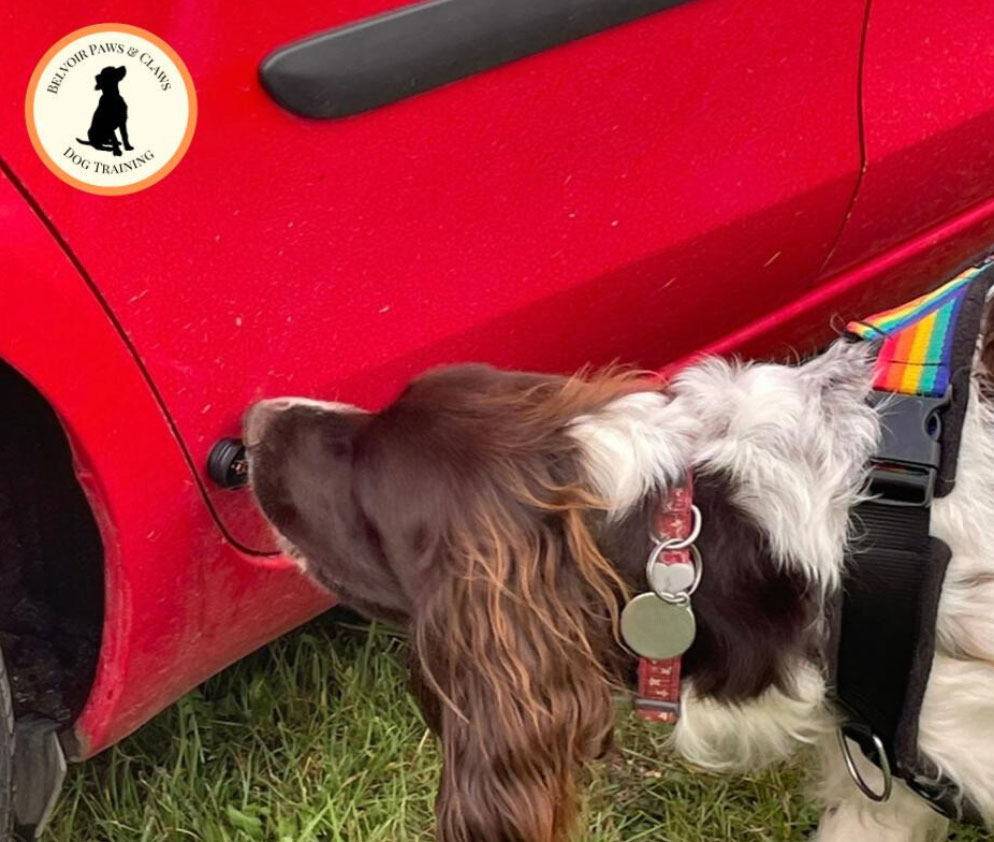
Dog trainers now offer scent detection training courses for fun, it is good for tiring dogs out as it uses their brain, building a stronger bond between the owner and their dog, scent work can also help with reactive dogs and nervous dogs. Having done several courses, we can highly recommend them.
The Emotional Connection Between Dogs and Their Sense of Smell
A dog’s sense of smell is intricately linked to their emotional world, weaving a sensory tapestry that shapes their experiences and interactions. Scents can evoke vivid memories and strong emotions, much like a particular fragrance might remind us of a cherished moment or a loved one. This olfactory-emotional connection enables dogs to navigate their environments with a depth of understanding that is profoundly different from our own.
For dogs, familiar scents can provide comfort and a sense of security. The smell of their human family, their home, or even a favourite toy can elicit feelings of joy and reassurance. Conversely, unfamiliar or threatening scents can trigger anxiety or alertness, showcasing the strong bond between their sense of smell and their emotional states.
Moreover, dogs often use their noses to communicate and bond with other dogs and humans. A friendly sniff during a greeting or the investigative sniffs they give each other provide essential information about identity, emotional state, and even health status. This behaviour underscores the importance of scent in their social structures and relationships.
In essence, a dog’s sense of smell is a key component of their emotional and social lives. It helps them form connections, understand their surroundings, and maintain a sense of well-being. This sensory ability is a constant thread in the fabric of their daily experiences, enriching their lives in ways that we are only beginning to understand.
Fun and Surprising Facts About Dogs’ Sense of Smell
Dogs’ sense of smell is not only extraordinary but also packed with fascinating quirks and capabilities. For example, did you know that
- each dog’s nose has a unique pattern, much like human fingerprints. This means that no two dogs have the same nose print. Moreover,
- the wetness of a dog’s nose is vital for capturing scent particles, enhancing their ability to detect odours.
Another intriguing fact is that
- dogs have a special organ called the vomeronasal organ, or Jacobson’s organ, located on the roof of their mouth. This organ allows them to detect pheromones, chemical signals that carry information about other animals’ identities, reproductive status, and even emotional states.
- dogs can detect the passage of time through scent. As scents degrade at predictable rates, a dog’s powerful nose can discern how long ago an event occurred based on the concentration of odour molecules. This ability gives them an incredible sense of time, allowing them to track and predict routines and changes in their environment.
Finally, dogs have an extraordinary capacity to sniff out emotions. They can sense changes in human body chemistry, such as the stress-related hormone cortisol, helping them respond to our emotional states with remarkable empathy and understanding.
Further reading on dogs scent ability.
